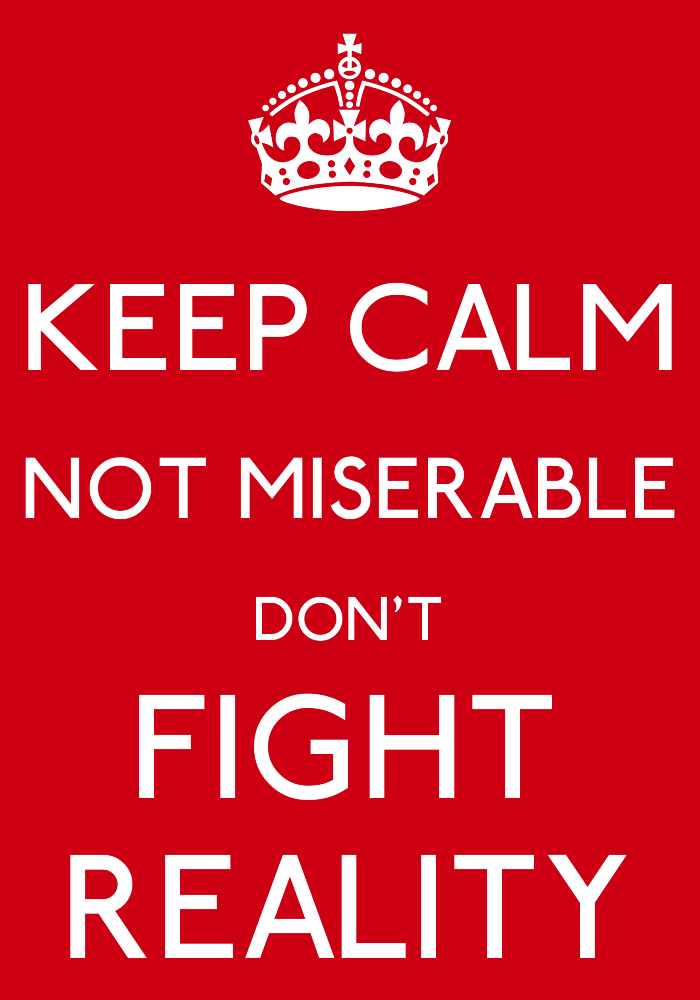
Is Fighting Reality Making You Miserable? – Episode 513
Listen to this Podcast Now >
Listen to this podcast on Spotify, Apple podcasts, Soundcloud
Watch on You Tube: https://youtu.be/eIfMHpmujIQ
 Before we dive in, let me tell you a little bit about what I do — because if you’re new here, I want you to know who you’re listening to and why any of this matters.
I’ve been a certified hypnotherapist for over 23 years. And I want to say something about that, because 23 years is a long time. I’ve had a lot of jobs in my life. A lot. And this is the only one I’ve ever held for more than a few years. In fact, it’s lasted five times longer than any other job I’ve ever had.
And the reason is simple: I love it.
I love helping people. I love the work. I love that what I do actually makes a difference in people’s lives. I help people let go of anxiety, break bad habits, build confidence and self-esteem, and get rid of what I call stinking thinking — the kind of negative, self-defeating thought patterns that keep us stuck and miserable.
If any of that sounds like something you could use, read to the end and I’ll tell you how to get in touch.
But for now — let’s get into today’s episode.
Is fighting reality making you miserable?
And before you answer that — let me ask you something else.
How much of your day do you spend wishing things were different than they are?
Wishing people were different. Wishing situations were different. Wishing the world would just cooperate with how you think it should be?
If you’re anything like most of the people I work with — and honestly, like most humans on the planet — the answer is probably: a lot.
And here’s the thing. We’re living in a moment right now where fighting reality has become almost a national pastime. Turn on the news, scroll through social media, sit down at a family dinner — and you’ll find people absolutely at war with what is. Outraged. Indignant. Convinced that reality is deeply, personally wrong and needs to be corrected immediately.
And look — I get it. There’s a lot going on. There’s a lot to process. A lot that feels genuinely difficult and uncertain.
But here’s what I’ve learned in 23 years of working with people:
There is no faster way to make yourself absolutely miserable than to spend your life fighting against what is.
And there is no faster road to peace than learning — really learning — to accept what is.
So that’s what we’re going to talk about today.
THE SERENITY PRAYER
Let me start with something that has been around for a long time and for very good reason.
You’ve probably heard it. It’s called the Serenity Prayer.
“God or Goddess, or Universe or Creator ( or whatever work for you), grant me the serenity to accept the things I cannot change, the courage to change the things I can, and the wisdom to know the difference.”
Now, regardless of your religious or spiritual beliefs — this prayer contains one of the most practical and psychologically sound pieces of wisdom ever put into words.
Accept the things I cannot change.
Change the things I can.
And have the wisdom to know the difference.
Simple. Profound. And for most of us — incredibly hard to actually do.
Because here’s what we tend to do instead. We spend enormous amounts of mental and emotional energy fighting against things we cannot change. And we feel helpless and stuck about things we actually could change, if we just made a decision and took action.
We’ve got it completely backwards.
And the cost of that — in terms of stress, overwhelm, anxiety, exhaustion, and misery — is enormous.
WHAT IS REALITY?
So let’s talk about reality for a minute.
What is reality?
At its most basic level, reality is what you perceive. It’s what’s actually happening — right now, in front of you — as opposed to what you think should be happening, what you wish was happening, or what you’ve decided should be different.
Now, here’s where it gets interesting. Two people can experience the exact same situation and make completely different meaning out of it. Based on their history, their beliefs, their conditioning — they’ll each have a different experience of the same reality.
So reality is partly objective — things happen — and partly subjective — we interpret what happens through the filter of our own minds.
And here’s the problem: most of us don’t realize we’re doing that. We think our interpretation of reality IS reality. We think the way we see things is simply the way things are.
But it isn’t. Not always.
And when our interpretation of reality is that everything is wrong, everyone is failing us, and nothing is the way it should be — we suffer. Deeply.
THE TRAFFIC EXAMPLE
Let me give you a simple, relatable example.
Let’s say that you live in the Los Angeles area, like I do. Or any major city, really. You decide to drive on the freeway. And then — and here’s the shocking part — there’s traffic.
Now, I know. Unbelievable.
And yet, every single day, people lose their minds over this. Road rage. Honking. Screaming. Stress responses that would make you think they’re being chased by a predator, not sitting in a car on the 210.
But here’s what is: if you drive a car on freeways in Los Angeles, there is going to be traffic. That’s reality. You may not like it. You may wish it were different. But wishing the 405 didn’t have traffic is about as useful as wishing it didn’t rain.
Now — can you do something about it? Sometimes, yes. You can use Waze or some other navigation tool. You can take a different route. You can leave earlier. You can take public transportation. You can work from home. You can ride a bike.
But if you’ve made the choice to drive the freeway at rush hour — you’ve also made the choice to encounter traffic. And fighting that reality, getting furious about it, letting it ruin your mood and your morning — that’s a choice too. And it’s a choice that costs you.
Same thing with the weather. It’s going to rain sometimes. It’s going to be hot. It’s going to be cold. But if you know bad weather is coming, you can prepare for it. You can grab an umbrella. You can dress accordingly. You can work with reality instead of against it.
That’s the difference between someone who is constantly at war with life — and someone who moves through life with a little more ease and grace.
WHAT WE DO INSTEAD
Here’s what fighting reality actually looks like in everyday life.
It’s the person who has a complaint about everything.
Nothing is okay. Everything should be different. The people at the top should be making different decisions. My parents should be different. My partner should be different. My friends should be different. My coworkers should be different. The whole world should just be different.
And I want to be clear — I’m not talking about healthy discernment. I’m not saying you should accept mistreatment or injustice without speaking up. There’s absolutely a time and place for saying “this is not okay and I’m going to do something about it.”
What I’m talking about is the chronic, relentless, exhausting habit of being at war with reality. Of spending your mental and emotional energy resisting what is — instead of dealing with what is.
I know people — more than one — who walk around saying things like “people are so stupid. I can’t stand people. Why are people like this?”
And look — yes. Some people are going to disappoint you. Some people are going to break their promises. Some people are going to be unkind, selfish, or unreliable. That has been true of human beings for about 200,000 years. It’s not new. It’s not getting fixed anytime soon.
Some people are going to be wonderful. Generous. Loving. Trustworthy. And some people aren’t. That’s what is.
Sometimes it rains. Sometimes it’s sunny. Sometimes you have a great day. Sometimes you have a terrible day. Sometimes things go your way. Sometimes they absolutely don’t. Good times and bad times — that’s the nature of life. That’s what is.
And fighting that — exhausting yourself against the reality of human nature and the nature of life — is, as I said, one of the most reliable ways to make yourself completely miserable.
THE SHOULD PROBLEM
There’s a phrase I use with my clients that I want to share with you.
Stop shoulding all over yourself.
Every time you say “this shouldn’t be this way” or “they should be different” or “I shouldn’t have to deal with this” — you’re creating a gap. A gap between the way things are and the way you’ve decided they should be. And that gap — that space between what is and what you think should be — is where suffering lives.
The traffic should be different. My boss should treat me better. The economy should be in better shape. My body should look different. My kids should listen to me. Life should be easier.
Should, should, should.
And I’m not saying these things don’t matter. I’m not saying you can’t work toward change. But when your entire experience of life is filtered through a lens of “this shouldn’t be this way” — you’re going to be miserable. Because reality doesn’t care about your shoulds.
Reality just is.
WHAT YOU CAN CHANGE
Now here’s where I want to make something very clear, because I don’t want you to walk away from this episode thinking I’m telling you to be passive. To just roll over and accept everything without question.
That’s not what I’m saying at all.
What I’m saying is this: there are things you can change, and there are things you can’t. And the most important skill you can develop — the one that will bring you the most peace and the most power — is the ability to tell the difference.
Because when you’re clear about what you can change — you can take action. You can make a decision. You can move. You can improve the situation.
And when you’re clear about what you can’t change — you can stop wasting energy fighting it. You can accept it. You can adapt. You can figure out how to be your best in the face of it.
Here’s a question I find really useful:
How can I make this better?
That’s it. Simple question. How can I make this better?
Because when you ask that question, something interesting happens in your mind. It automatically opens up the possibility that improvement exists. And if improvement is possible — your mind will start looking for it. That’s how the brain works. Ask a better question, get a better answer.
Sometimes the answer will be clear — yes, there’s something I can do here. And you do it.
And sometimes the answer will come back: there’s nothing you can do to change this. And that’s when acceptance becomes not just helpful, but necessary. That’s when the Serenity Prayer might become your best friend.
ACCEPTANCE IS NOT GIVING UP
I want to address something that comes up a lot when I talk about acceptance.
People sometimes confuse acceptance with giving up. They think accepting a situation means you’re okay with it. That you’re approving of it. That you’re weak.
That’s not what acceptance means.
Acceptance simply means acknowledging reality as it is. It means stopping the war with what you cannot change — so that you can free up your energy for what you actually can influence.
Think about it this way. If you’re in quicksand and you fight it — you sink faster. But if you stop struggling and stay calm — you can actually work your way out.
Acceptance is not weakness. Acceptance is emotional intelligence.
And some things take time to accept. Grief. Loss. Profound disappointment. Major life changes. These things don’t get accepted overnight, and that’s okay. That’s part of the human experience. The goal isn’t to bypass the feelings — it’s to eventually stop fighting reality and find a way to move forward through it.
The key word is eventually. You don’t have to be okay with everything right away. But the longer you stay in resistance — in that war with what is — the longer you stay stuck in suffering.
THE CURRENT MOMENT
I want to speak to something that I think is especially relevant right now.
We are living in a time of enormous uncertainty and change. Politically, socially, economically — things feel unstable. Things feel unpredictable. A lot of people are anxious, overwhelmed, and yes — fighting reality on a daily basis.
And I understand that. I really do because I do the same thing sometimes.
But here’s what I’ve noticed: the people who are suffering the most right now are not necessarily the ones dealing with the most difficult circumstances. They’re the ones who are most at war with what is. Who are spending every day in a state of outrage, resistance, and refusal to accept that this is the reality we’re currently living in.
That doesn’t mean you have to like it. It doesn’t mean you shouldn’t advocate for change. It doesn’t mean you shouldn’t vote, speak up, get involved, do what you can.
But it does mean that living in a constant state of resistance to reality — letting it consume your peace, your joy, your presence — that’s a choice. And it’s a choice that hurts you more than it changes anything.
You can be engaged without being consumed. You can care deeply without being destroyed. You can work for change while also accepting what is.
That’s not giving up. That’s wisdom.
THE WAYNE DYER STORY
I want to close with a quote that has stayed with me for a long time. It comes from the write Wayne Dyer — someone who has had a profound influence on my life and my thinking.
But first, let me tell you how I discovered Wayne Dyer. Because it’s a story I love.
I was in high school, poking around in my parents’ bedroom — as teenagers do — and I spotted a book on the nightstand. The title caught my eye immediately.
Your Erogenous Zones.
Now. As a teenage boy, I thought — well, this sounds interesting. This sounds like exactly the kind of book I should be reading right now.
So I picked it up. Opened it. Started reading.
And very quickly realized it was not at all what I thought it was.
The book was called Your Erroneous Zones. Erroneous. As in mistaken. As in the habitual patterns of thinking that lead us away from joy and fulfillment.
Not quite what I had in mind.
But here’s the thing — I kept reading. And that book genuinely changed my life. It was one of the first books that helped me understand that the way we think about our lives has everything to do with the quality of our experience.
So Wayne Dyer — I owe you one. Even if it wasn’t the book I was looking for.
Here’s the quote I want to leave you with today. It’s one of my favorites:
“Peace is the result of retraining your mind to process life as it is, rather than as you think it should be.”
Read that again.
“Peace is the result of retraining your mind to process life as it is — rather than as you think it should be.”
That’s it. That’s the whole game. Right there in one sentence.
Stop fighting what is. Start working with what is. Accept what you cannot change. Change what you can. And have the wisdom — and the humility — to know the difference.
So let me bring it all together.
Fighting reality is exhausting. It’s one of the primary sources of stress, anxiety, and misery in modern life. And it’s something that most of us do every single day — often without even realizing it.
The antidote isn’t passivity. It isn’t rolling over and accepting everything without question. It’s developing the wisdom to see clearly — what is, what you can change, and what you need to let go of.
It’s asking yourself: how can I make this better? And being honest about the answer.
It’s practicing acceptance — not as weakness, but as intelligence.
And it’s remembering, on the hard days especially, the words of the Serenity Prayer:
“God, grant me the serenity to accept the things I cannot change, the courage to change the things I can, and the wisdom to know the difference.”
That’s not just a prayer. That’s a roadmap to peace.
And peace — real, genuine, hard-won peace — is worth striving for. Especially right now.
Thanks for reading this and/or listening to Ted in Your Head podcast. If today’s episode resonated with you, please subscribe, leave a review, and share it with someone who might be fighting a battle they can’t win.
You can reach out for a complimentary 30-minute phone consultation at tedmoreno.com/contact.
We’ll find out if hypnotherapy is right for you — and if you’re ready, we can get started.
I’ll see you next time. Until next time — remember: your mind is powerful. Use it on purpose. And take care of yourself — because the world needs the best version of you.
Ted